
Creating this site has been a rewarding experience and, a few weeks in has already been worth the time I have invested. If you are a student, recent graduate or someone who is finding it difficult to land that next marketing role, I highly recommend creating a personal website yourself. But don’t be fooled, it was no picnic. Sponsored by a few very, very late nights and the power of coffee, here are five things that I learnt on my journey, in the hopes of helping you on yours.
But First, Why Create a Personal Website?
It helps you to be head and shoulders above the rest: Having a personal website can be a great support tool in your search for the next opportunity. CV’s are dull. The formatting is also very reliant on experience and accomplishments which can leave individuals with little experience, such as recent graduates, fighting over adjectives to sell their strengths and genuine passion. A website gives you more than an A4 sheet to show a potential recruiter what you are made of. Ultimately, a website could be the deciding factor between you and another person with similar experiences. The job market is tough right now. Job hunting can be a full-time job in itself. Creating a website can also be a fun and rewarding experience, a chance for you to show your creativity without compromising on time spent working towards the next role.
It’s dynamic, up to date and ever-changing: Recently accomplished something or took part in a great project? Let people know. This will form the basis of a portfolio and can not only show what you can do but how you develop. Keeping a website consistently updated and coupled with regular social media use can get you noticed by people you maybe able to get in front of using other methods.
Helps you to develop new skills: Having a platform can help you to take the marketing theory you learn and find out what works for you and your purposes. Some of the skills you pick up include, getting to grips with the basics of SEO, UX or what content works for specific audiences.
5 things I have learnt.
Fail to Plan, Plan to Fail.
Like many others, I am used to creating detailed briefs for projects like this, describing to someone else exactly where we are now, what we would like to achieve and how to measure success. We do this to ensure the project is focused and delivered to expectation, so it made sense to me to do this for myself. Having a plan kept me fixed on the end goal and made some of the creative decisions a lot easier. Having a brief also helps to prioritise elements that primarily benefit the outcome you would like to achieve. For example, are you creating the website to sell yourself to a potential employer? Are you using it as a support to bolster another channel with content such as social media outlets like Instagram and LinkedIn?
For those who are just starting in the marketing world and have yet to write a brief, Smart Insights have created a blog on this: How to write a creative brief that gets results | Smart Insights
You Don’t Have to be a Graphic Guru or Coding Genius. There is a Solution For All Levels.
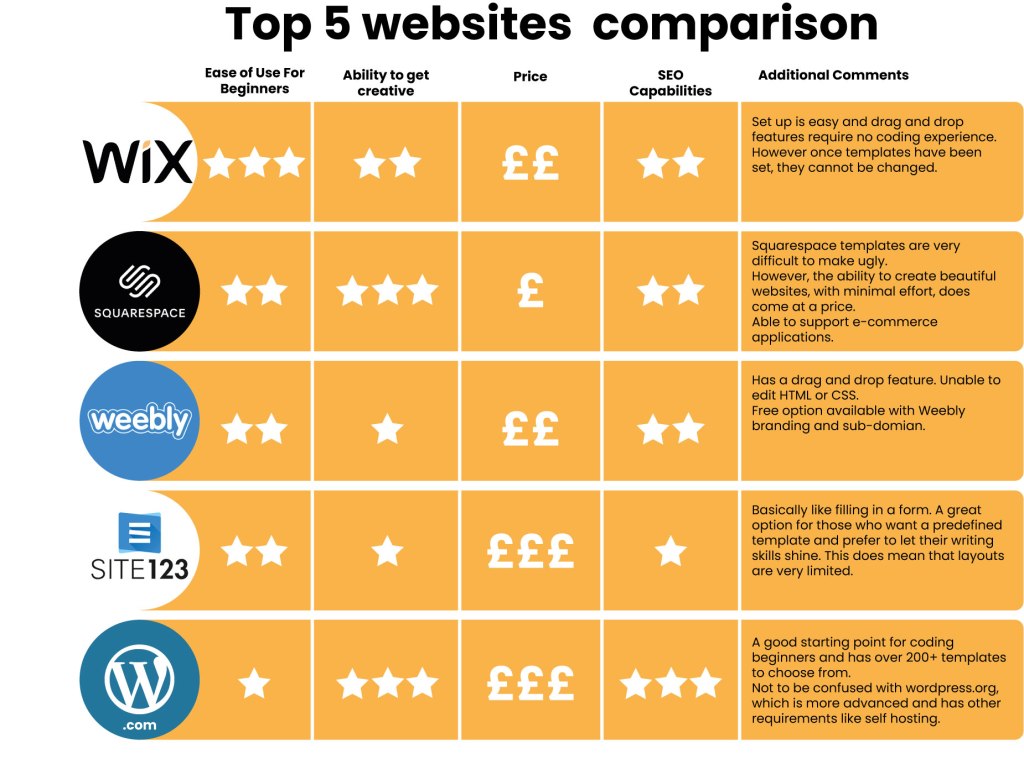
The website building of today is not like it used to be. A solution is out there for everyone, whether you are a wizard with HTML, a building beginner or somewhere in-between. Every option does come with pros and cons. I highly recommend putting in the time to research what is best for you and your needs before building. To clarify these suggested websites are recommended based on motivations of creating a blog site or personal website. For a business looking to expand their online presence, there are other approaches which would be more suitable.
Here is a brief overview of the top five options: Squarespace, WordPress.com, Site 123, Wix and Weebly.
Rome Wasn’t Built In A Day, Neither is the Perfect Website.
For all the perfectionists out there, building a website will be a never-ending task. There is always something you can add to make it bigger and better. And whilst it is great to have ambitions, don’t be tempted to put off pushing your website live because it doesn’t have all the bells and whistles you want. Instead, establish stages of web development that delivers the basic requirements first and then builds on that foundation. This is where your plan comes into play. Keep in mind, there is a difference between improving a website after going live and fixing a website. It’s important to make sure everything works and your UX is top-notch or you will put visitors off from returning.
There are Friends in the Community That Feel Your Pain.
According to research done by Tillburg University, there are over 4 billion pages on the indexed web. All of those pages were built by someone. It’s safe to say, there is a pretty sizable community out there, that have already gone through what you are about to. My advice? Don’t be an island. There are a few notable forums you can turn to for help. They can also give you an outsiders opinion on your ideas.
Some of the forums I have used or come across in the past:
Coffeecup forum: https://www.coffeecup.com/forums/
Digital point: https://www.digitalpoint.com/
Warrior Forum: https://www.warriorforum.com/website-design/
Problogger Facebook Community: https://www.facebook.com/groups/probloggercom
Not too keen on relying on the kindness of strangers? Send your website to family and friends. They may not be able to help you on the more technical questions, but they can help to understand if your website is aesthetically pleasing, identify issues like broken links and give you some great insights into how they use the website.
Just Do It.
Putting yourself out there can be a little scary creating and online presence, in particular, feels more permanent compared to a traditional networking method. But once you have taken the plunge, you will wonder why you didn’t do it sooner.
Still, have reservations or looking to get started? Drop me a message, I am always happy to have a chat.
 Allen Keys | Sharing marketing ideas, tools and resources.